What is Document Operations?
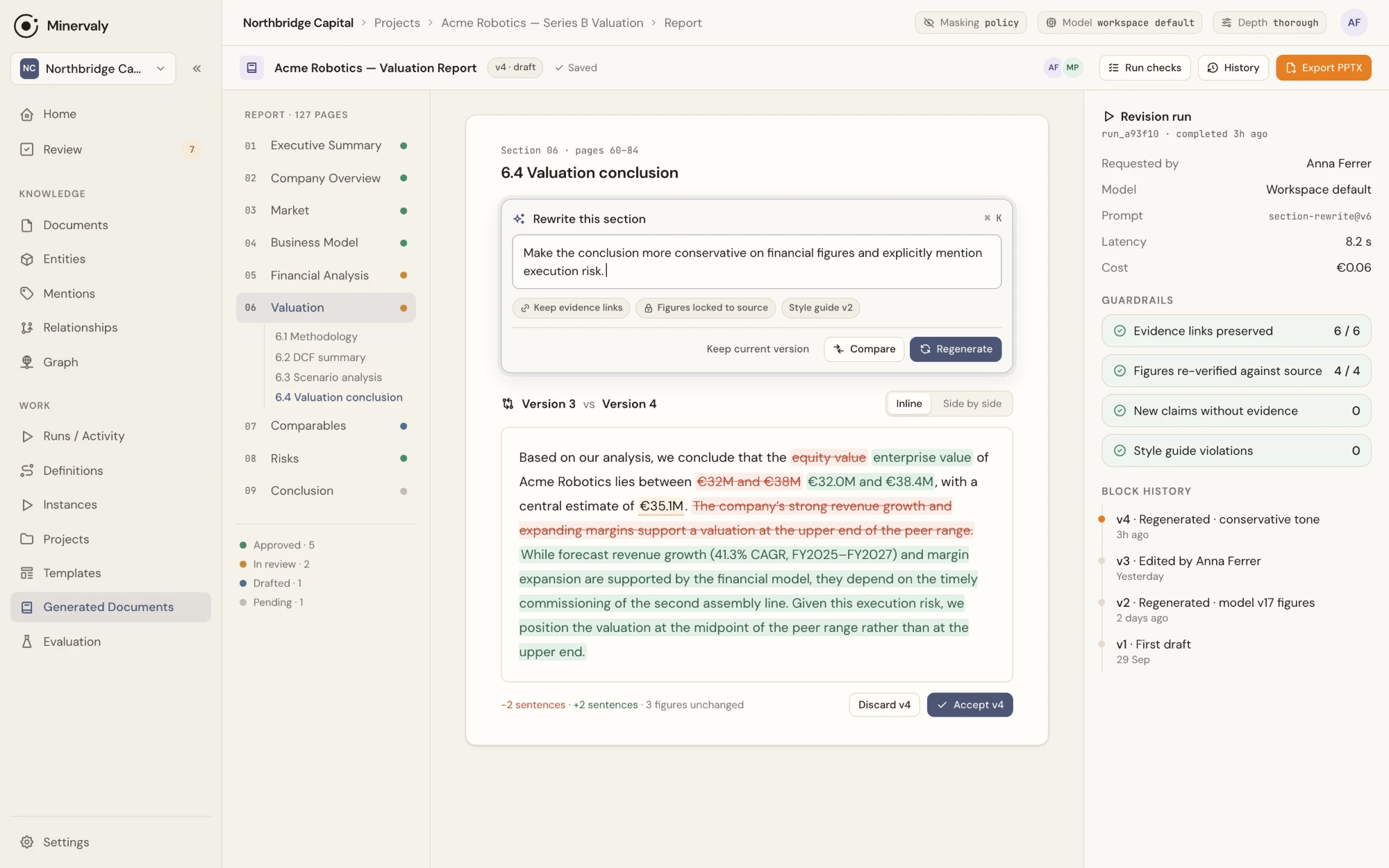
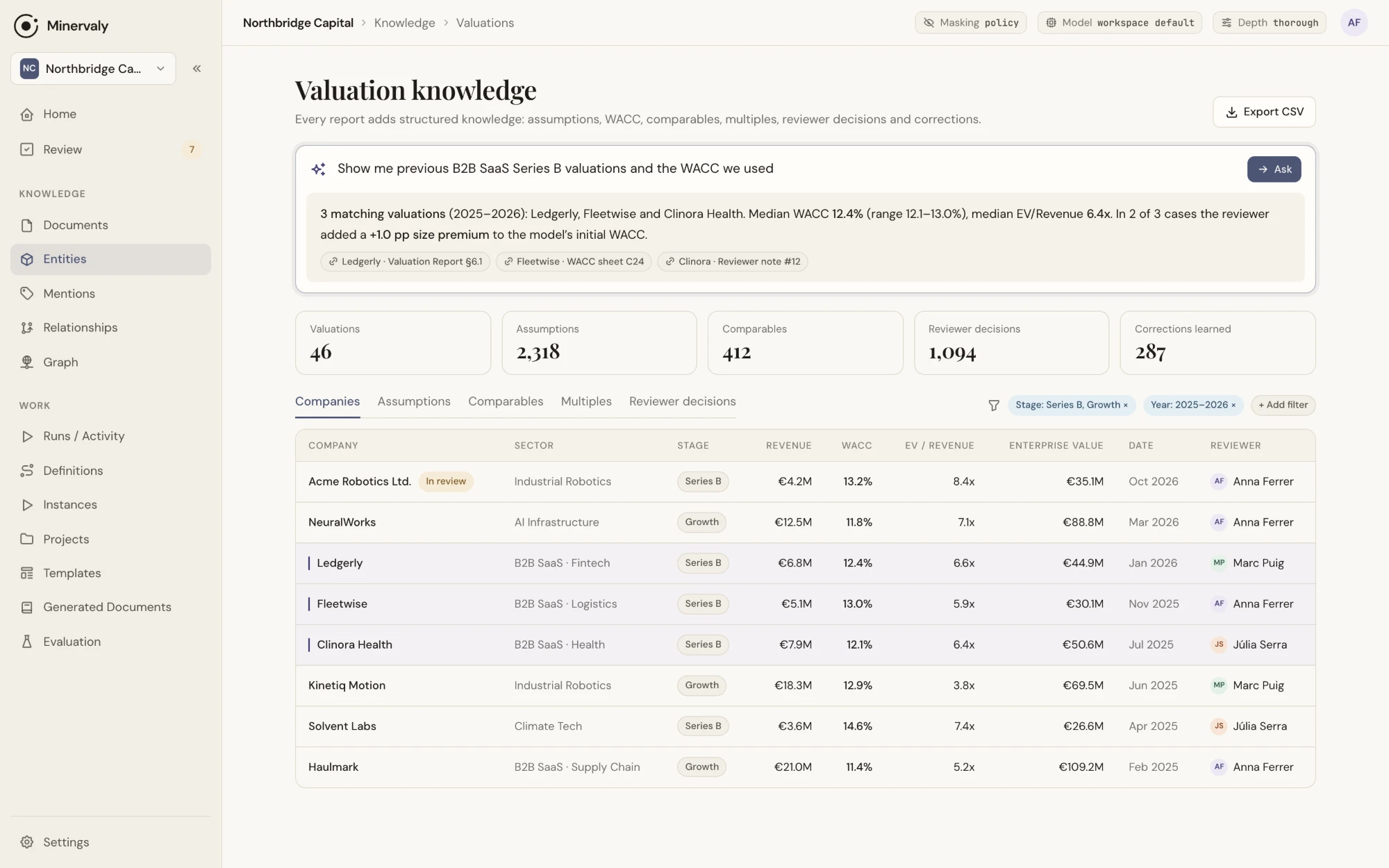
Document Operations turns incoming documents into checked information, human decisions and usable outputs. Minervaly connects those steps and keeps the source alongside each result.
What does the 30-minute review include?
We identify the documents, the manual steps and whether a bounded proof makes sense. It is not a live calendar: we confirm a time after looking at your process.
What does the paid proof buy, and what if the result is No-Go?
You buy the agreed deliverables: process map, specification, functional proof, evaluation and production recommendation. If the result is No-Go, the work stops there. The proof fee is not refundable.
What is the total cost if we continue?
Essential: €9,500 implementation including the €2,500 proof (€7,000 remaining), then €7,200 per year. Operate: €18,500 including the €4,500 proof (€14,000 remaining), then €18,000 per year. Amounts exclude taxes.
Why is there a recurring operation fee?
After implementation, the workflow has to keep running: hosting, checks, review tools, updates and operational follow-up. Recurrence is the cost of keeping the process in production.
What data sample and involvement do you need?
A representative sample of one document family, a process owner, someone who can review outputs, and a short weekly session during the proof. The sample must be legally usable.
What happens with ambiguous cases and errors?
Ambiguous cases and errors go to human review. Your team remains responsible for accepting material results. Minervaly prepares the work and flags exceptions; it does not claim infallibility.
What is the difference between proof and production?
The proof is a bounded test on representative data, with agreed criteria. It is not production. It does not include new connectors, SLA or custom development.
Does the guarantee cover ROI or zero errors?
No. The guarantee covers the agreed deliverables of the proof, not a guaranteed return and not error-free operation.
Are VPC and on-premise included in the €2,500 proof?
No. VPC and on-premise need a specific scope and budget. They are not part of the Workflow Proof automatically.