Measured: a daily payroll batch went from 3–4 hours to 2 minutes of review

AI literacy · EU AI Act Article 4

AI literacy for teams that use AI at work

Practical training, assessment and verifiable credentials designed to help organisations build responsible AI capabilities and document their AI literacy measures under Article 4 of the EU AI Act.

  • Assessment-based credential
  • Verifiable credential ID
  • Aligned with Article 4
  • On-site or online
Illustrated landscape in Minerva's visual style
Minerva logo Minerva Data Solutions Valid

Minerva AI Literacy Practitioner

Credential IDMDS-AIL-SPECIMEN

What does Article 4 of the EU AI Act require?

Article 4 of the EU AI Act asks providers and deployers of AI systems to take measures to support the development of AI literacy among their staff and other people who operate or use AI systems on their behalf. It has applied since 2 February 2025.

Those measures should take into account:

  • existing technical knowledge
  • experience, education and training
  • the context in which AI systems are used
  • the risks associated with those systems, as the European Commission's guidance recommends
European Commission: AI literacy questions and answers(opens in a new tab)
  1. 01

    No single mandatory course

    The Commission's guidance is explicit: there is no one-size-fits-all format, and no specific certificate is required.

  2. 02

    Fit to roles, systems and risk

    What a finance analyst using a chat assistant needs differs from what a team operating a high-risk system needs. Training should reflect that.

  3. 03

    Keep a record of what you did

    The Commission notes that organisations can keep an internal record of their training and guidance initiatives as evidence of their measures.

What should AI literacy training cover?

Outcomes, not a syllabus. Each programme is built around what people need to do safely and well with the AI tools they actually use.

Understand

  • How modern and generative AI work

    Enough of the mechanics to reason about outputs, not just consume them.

  • Capabilities and limitations

    Where today's systems help, where they fail, and why the boundary moves.

  • Hallucinations and output verification

    Recognising fabricated content and checking outputs before they are relied on.

Use safely

  • Privacy and confidential data

    What can and cannot go into a prompt, and how confidential information leaks.

  • Intellectual property

    Ownership, licensing and attribution questions around inputs and generated work.

  • Responsible use at work

    Practical rules for everyday tasks: drafting, summarising, searching and analysing.

  • Shadow AI

    Why unapproved tools appear, what they put at risk, and how to bring them into the open.

Govern

  • Bias and inappropriate automation

    Spotting skewed outputs and deciding when a task should not be automated.

  • Human oversight

    Keeping a person meaningfully responsible for decisions AI contributes to.

  • Your organisation's role: provider or deployer

    What it means for your organisation to provide or deploy an AI system.

  • EU AI Act essentials for everyday use

    The parts of the EU AI Act that matter for everyday use, without the legal jargon.

Programmes are adapted to each organisation and role: the tools in use, the data involved and the decisions AI supports.

The credential

Minerva AI Literacy Practitioner is a Minerva-issued credential for participants who complete the programme and pass the defined assessment.

Minerva logoMinerva Data Solutions
Valid

Credential

Minerva AI Literacy Practitioner

Credential holder

Specimen Holder

Programme
AI Literacy at Work · v1.0
Issued
October 1, 2026
Workload
8 hours
Assessment
Passed · 86% (pass mark 75%)
Delivery format
On-site
Issuer country
Andorra

Learning outcomes

  • How modern and generative AI work
  • Capabilities and limitations
  • Hallucinations and output verification
  • Privacy and confidential data
  • Intellectual property
  • Responsible use at work
  • Shadow AI
  • Bias and inappropriate automation
  • Human oversight
  • Your organisation's role: provider or deployer
  • EU AI Act essentials for everyday use

Credential ID

MDS-AIL-SPECIMEN

Verify at

minerva-ds.com/verify/MDS-AIL-SPECIMEN

Specimen

  • Verifiable

    Every credential receives a unique ID and can be verified through Minerva.

  • Assessment-based

    Practitioner credentials require successful completion of an assessment rather than attendance alone.

  • European-aligned structure

    The credential is structured using the standard information elements of the European approach to micro-credentials for lifelong learning and employability.

European approach to micro-credentials(opens in a new tab)

Two certificate types

Certificate

Certificate of Completion

Confirms participation in an eligible Minerva programme. Attendance-based, with no assessment.

Credential

Minerva AI Literacy Practitioner

Training plus a passed assessment. Issued with a unique ID, the learning outcomes covered and a public verification page.

Minerva AI Literacy credentials are independently issued by Minerva Data Solutions. They do not constitute certification or endorsement by the European Union.

Evidence for the organisation

Alongside individual credentials, your organisation receives an AI Literacy Training Record: a structured record designed to help organisations document the AI literacy measures they have undertaken.

It is training documentation, not a certificate of legal compliance. How it fits into your wider AI governance remains your organisation's assessment.

AI Literacy Training Record
Example structure
Organisation
Legal entity and business unit trained
Session
Programme delivered and its scope
Date
Delivery date or dates
Duration
Contact hours and any self-paced work
Learning outcomes
Outcomes covered in this session
Participant profiles
Roles and AI systems in scope
Programme version
Version of the materials used
Instructor
Who delivered the training
Credentials issued
Certificates and Practitioner credentials, by ID

How is the training delivered?

Scope and duration are agreed with each organisation, based on roles, tools and risk context.

  1. 01

    On-site

    Sessions at your offices, in small groups that leave room for real questions.

  2. 02

    Online

    Live remote sessions for distributed teams, with the same assessment.

  3. 03

    Tailored corporate sessions

    Examples and exercises built on your tools, documents and policies.

  4. 04

    Role-specific programmes

    Separate tracks for leadership, operational teams and technical staff.

Built around European standards

We reference European frameworks where they apply, and only state a status once it has been obtained.

Micro-credential information elements
ElementMinerva AI Literacy Practitioner
Learner identificationHolder name (contact details kept private)
Title of the credentialMinerva AI Literacy Practitioner
Country of the issuerAndorra
Awarding bodyMinerva Data Solutions
Date of issueRecorded on each credential
Learning outcomesListed on each credential
Notional workloadStated in hours. No ECTS credits are assigned.
Qualification levelNot applicable. No EQF level is assigned.
Type of assessmentIndividual written assessment with a defined pass mark
Form of participationOn-site, online or blended
Quality assuranceInternal programme review by Minerva Data Solutions
GradeAssessment score

Minervaly

From AI literacy to AI you can check

Training teaches people to verify outputs, protect data and keep a person accountable. Minervaly builds the same habits into recurring document work, so they hold on a busy day, not only in a workshop.

  • Every result links to its source

    Extracted fields and answers point back to the document fragment they came from.

  • Exceptions stop for a person

    Missing information, contradictions and edge cases are surfaced for human review before acceptance.

  • Decisions are recorded

    Human edits and approvals are kept with the case, with user, date and time.

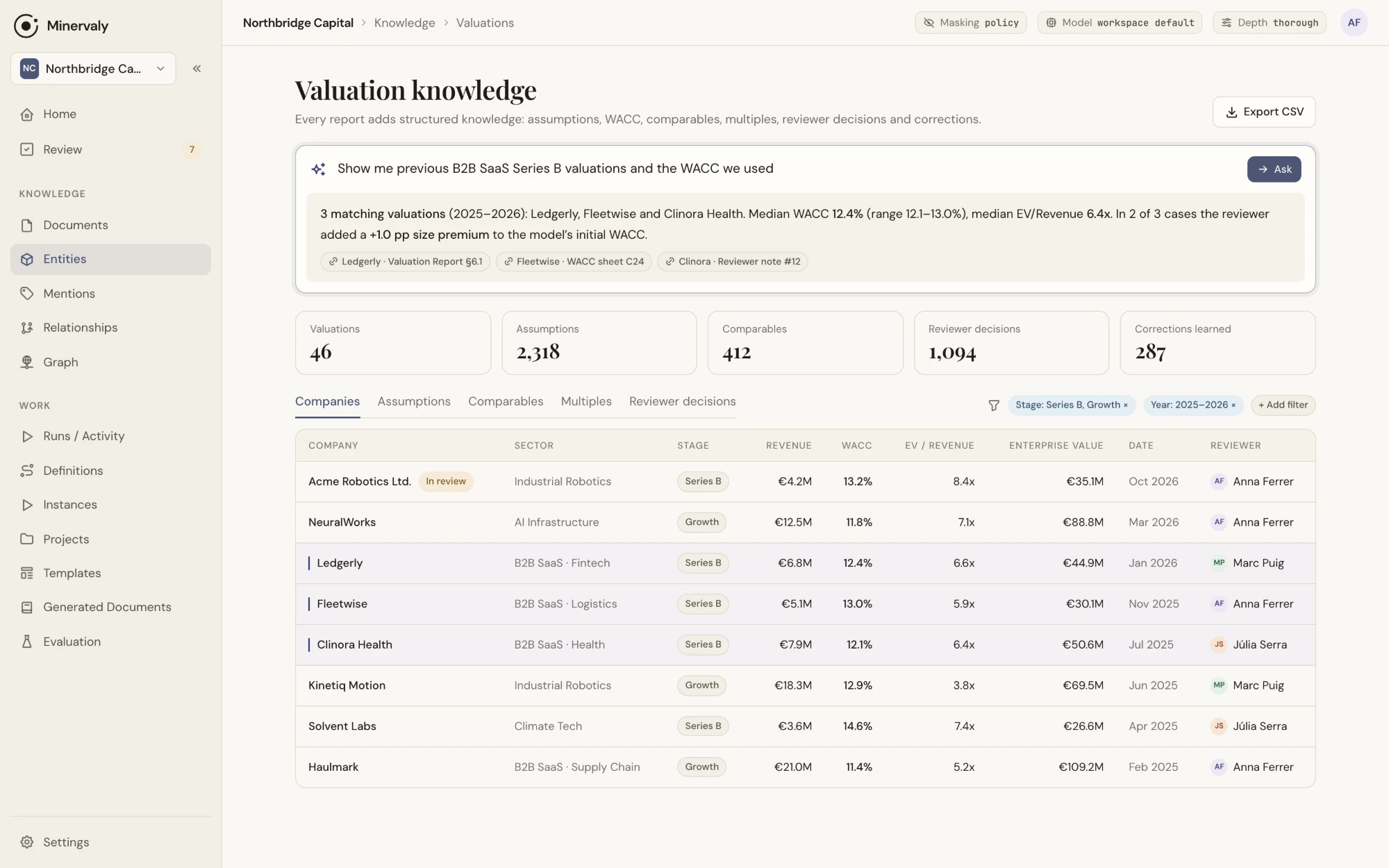
Minervaly valuation knowledge: previous valuations with WACC, multiples and reviewer, answered with links to the sources

AI literacy and Article 4: common questions

What is AI literacy under the EU AI Act?

It means people who build or use AI systems have the skills, knowledge and understanding they need for the systems they work with. In practice: knowing how the tools work, where they fail, what data they may receive and when a person must check the result.

Is AI literacy training mandatory under Article 4?

Article 4 requires providers and deployers to take measures to support AI literacy, but it does not prescribe one course. The European Commission says the right measure depends on roles, systems and risk, and that simply asking staff to read instructions for use is often ineffective. Training is the most common measure.

When did Article 4 start to apply, and did the 2026 amendment remove it?

Article 4 has applied since 2 February 2025. The Digital Omnibus on AI amended it in 2026: AI literacy remains an obligation for providers and deployers, but no specific or "sufficient" level is mandated.

Does Article 4 apply if our staff only use ChatGPT or Copilot?

Yes. The European Commission states that a company whose employees use ChatGPT, for example to write or translate text, should inform them about the specific risks, such as hallucination. Using a third-party assistant makes your organisation a deployer.

Who supervises Article 4?

National market surveillance authorities, not the European AI Office. According to the Commission, they supervise and enforce the rules from 2 August 2026.

Do we need a certificate to show AI literacy?

No. The Commission says no certificate is required and that organisations can keep an internal record of their training and guidance initiatives. Our AI Literacy Training Record is designed for exactly that.

Who should take part?

Anyone who operates or uses AI systems on your organisation's behalf, including contractors where relevant. We usually separate leadership, everyday users and technical teams.

How long does the training take?

It depends on roles, tools and risk. Scope and duration are agreed with each organisation; each credential states the workload in hours.

Does completing the programme make us compliant with the EU AI Act?

No training can guarantee that on its own. The programme is designed to support the AI literacy measures Article 4 asks for, and the Training Record helps you document them. Your wider obligations depend on the AI systems you provide or deploy.

Is the credential an official EU certification?

No. It is issued independently by Minerva Data Solutions. Its information structure follows the European approach to micro-credentials, which is a set of recommended elements, not an EU certification scheme.

Can the programme use our own tools and policies?

Yes. Tailored sessions use your approved tools, internal AI policy and real, anonymised examples from your work.


Build AI literacy across your organisation

Tell us how your teams are using AI. We'll adapt the programme to their roles, tools and risk context.

contact@minerva-ds.com